
Who Is Beatrice Mtetwa?
Beatrice Mtetwa is one of Africa’s most celebrated and courageous human rights lawyers. Based in Harare, Zimbabwe, she has spent more than three decades defending journalists, political opponents, civil society leaders, and ordinary citizens against the abuses of successive authoritarian governments — first under Robert Mugabe, and more recently under his successor Emmerson Mnangagwa. She is the central figure of the 2013 documentary film Beatrice Mtetwa and the Rule of Law, which chronicles her work and her unwavering belief that the law must apply equally to everyone, including those in power.
Early Life and Education
Beatrice Mtetwa was born in 1957 and grew up on a farm in Swaziland (now Eswatini) without electricity or running water. She is the eldest daughter among 50 children; her father had six wives. She was the first in her extended family to attend high school, and she went on to study law at the University of Botswana and Swaziland, graduating with an LLB degree in 1981.
After qualifying as a lawyer, she moved to Zimbabwe shortly after it gained independence in the mid-1980s. Her first job was prosecuting cases for the new government of Robert Mugabe. Within a matter of years, however, she left that role — disillusioned by the selective justice she witnessed — and opened her own law firm. She began taking on the clients no one else would: defendants targeted by the government because of their politics, their journalism, or their courage in speaking out.
Her Legal Work in Zimbabwe
Mtetwa’s law firm, Mtetwa and Nyambirai, has grown into a full-service practice, but its reputation rests on human rights work that few other firms in Zimbabwe have been willing to undertake. Over the decades, she has represented:
- Journalists and media workers arrested or harassed for their reporting on the government
- Opposition politicians and activists, including the first MDC mayor of Harare, Elias Mudzuri, who was arrested and beaten after his election
- Human rights advocates, including Jestina Mukoko, director of the Zimbabwe Peace Project, who was abducted and held incommunicado for 89 days
- Farmers whose land was confiscated under the Fast Track Land Reform programme
- Ordinary citizens who were detained, beaten, or prosecuted simply for speaking out
One of her most notable early cases involved successfully challenging a section of Zimbabwe’s Private Voluntary Organizations Act that gave a government minister the power to dissolve or replace the board of any NGO — a move that threatened the entire civil society sector. She has also challenged election results, secured emergency court orders against unlawful detentions, and sued government officials in their personal capacity for damages arising from human rights abuses.
In the documentary, Mtetwa describes her motivation with characteristic directness: she does this work not for glory or money, not to antagonize the government, but because it is a job that must be done.
Arrests, Intimidation, and Resilience
Explore More
- The Defendants: Key Cases from the Documentary — Jestina Mukoko, Gift Phiri, Roy Bennett, and Elias Mudzuri
- About the Rule of Law — The film’s philosophical and historical context
- Distribution & Outreach — How the film reached global audiences
- Funders — The organizations and individuals who made the documentary possible
- Principals — The filmmakers and creative team
- Where Are They Now? (2025) — A current update on the people featured in the film
- Inviting International Human Rights Lawyers to the U.S. — Visas, speaking tours, and academic appointments
Her work has come at considerable personal cost. She has been beaten by police in the course of doing her job. She has been arrested and detained, most notably in March 2013, when she responded to an emergency call from a client and was held for eight days — initially denied bail even after the High Court ordered her immediate release. Amnesty International declared her detention an attack on the legal profession itself.
In August 2020, she was barred by a Harare magistrate from representing detained journalist Hopewell Chin’ono — her own co-producer on the documentary — and was threatened with a contempt of court referral. The legal community and international press freedom organizations condemned the ruling as a direct attempt to deny Chin’ono competent representation.
As recently as 2025, Mtetwa continues to speak out. She published an open letter to Zimbabwe’s Judicial Service Commission in June 2025, expressing continued concern about judicial independence and the rule of law in the country.
International Recognition and Awards
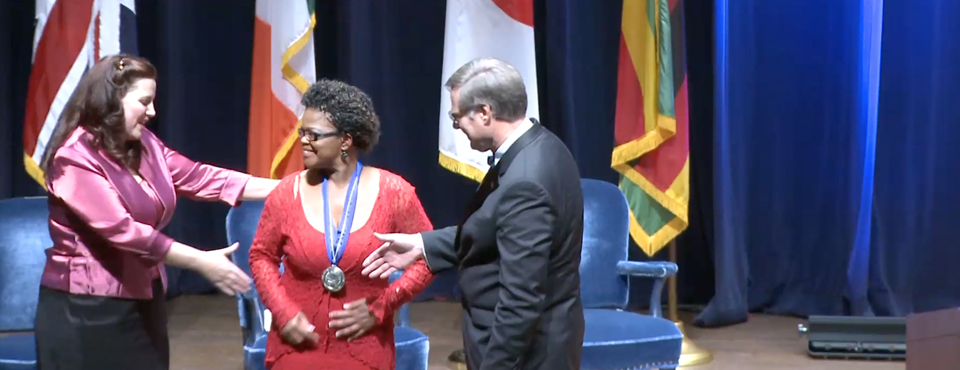
Beatrice Mtetwa’s work has been recognized by some of the world’s most prestigious institutions:
- Inamori Ethics Prize — Case Western Reserve University (2011)
- International Press Freedom Award — Committee to Protect Journalists (2005)
- International Human Rights Award — American Bar Association Section of Litigation
- Ludovic-Trarieux International Human Rights Prize — France (she is only the second African to receive this award, after Nelson Mandela)
- Ivan Allen Jr. Prize for Social Courage — Georgia Institute of Technology (2014)
- Honorary Doctorate — Rhodes University, South Africa (2016)
The Documentary Film
Beatrice Mtetwa and the Rule of Law is a 2013 documentary directed and produced by Boston-based filmmaker Lorie Conway, co-produced with Zimbabwean journalist Hopewell Rugoho-Chin’ono. The film was funded by the U.S. Institute of Peace, the International Bar Association, the Guardian’s Scott Trust Foundation, and others.
It has been screened at the London School of Economics, the World Justice Project Forum in The Hague, Georgia Institute of Technology, and law schools and human rights conferences around the world. A 30-minute educational version is available for classroom and institutional use. Learn more about screenings and educational distribution, or read about the film’s funders and supporters.
Why Beatrice Mtetwa Matters
The rule of law — the principle that no one, not even a head of state, is above the law — is easy to articulate and difficult to defend. Beatrice Mtetwa has spent her career making that defense concrete, in Zimbabwean courtrooms, often alone, often at personal risk. Her story is a reminder that legal institutions do not protect themselves. They are protected by lawyers who believe the job must be done.
Read more about the defendants whose cases are featured in the film, the filmmakers who made the documentary, or learn about the Rule of Law Film Project.